Tuesday, July 20, 2010

Working on Game Tools

Harn has a manor generation system. Along with my own Historical Sources, I think I can make my own suitable for Villa, Manor, or Fief. This is one of my many projects, and It will take some time to figure out. Previously I had a long bout in GURPS Mass Combat and found some problematic kinks in it. Particularly how economics of the town always fail to bring up the Historical force numbers I keep seeing.

I'm also making my own game system that would suit my simulation tastes. You will see the preliminary notes on it in Gameinthebrain blog where It is beginning to look a bit detailed. I'm planning to talk to the programmers in our company to see how much it would cost to computerize the character creation system I'm proposing. Yep this thing is going to be freaking detailed, even more Detailed then Harn... but not as constricting. The basic principles of the system it to able to define it with current biometric tools and formulas available.

I've been also making a Wilderness Encounter Map generator using tables. Along with it comes a legend for tactical map drawing with white board markers over a tactical hex grid. I will also ask how much that will cost as software.

Sorry for my long absence. I've been consolidating my gaming under effort lately. Something that can apply to my other game systems. The Villa and the Manor creation will be very useful for my 19th Century Spanish-Colonial Philippines setting called Mahadlika. So will the maps and encounter generator. I've noticed realism and creating a way to make more realistic simulationist game tools applies to many real world genres (with some tweeking).

Tuesday, March 9, 2010

Levant aka Modern Jordan, Lebanon, Israel, Palestine, and Syria.

Checking the wiki about each country and using google maps I found out that
  • Israel and Palestine: 22,000 sq km and 350 people per sq km
  • Lebanon: 10,000 sq km and 400 people per sq km
  • Jordan: 92,000 sq km and 63 people per sq km
  • Syria: 185,000 sq km and 110 people per sq km
I broke them down to using Medieval Demographics Made easyl
  • Israel and Palestine: 22,000 sq km and 35 people per sq km
  • Lebanon: 10,000 sq km and 40 people per sq km
  • Jordan: 92,000 sq km and 6 people per sq km
  • Syria: 185,000 sq km and 11 people per sq km
It is interesting to find out that in Roman times Levant had a population of 5M that progressed slowly towards 2M until the time of the Crusades.

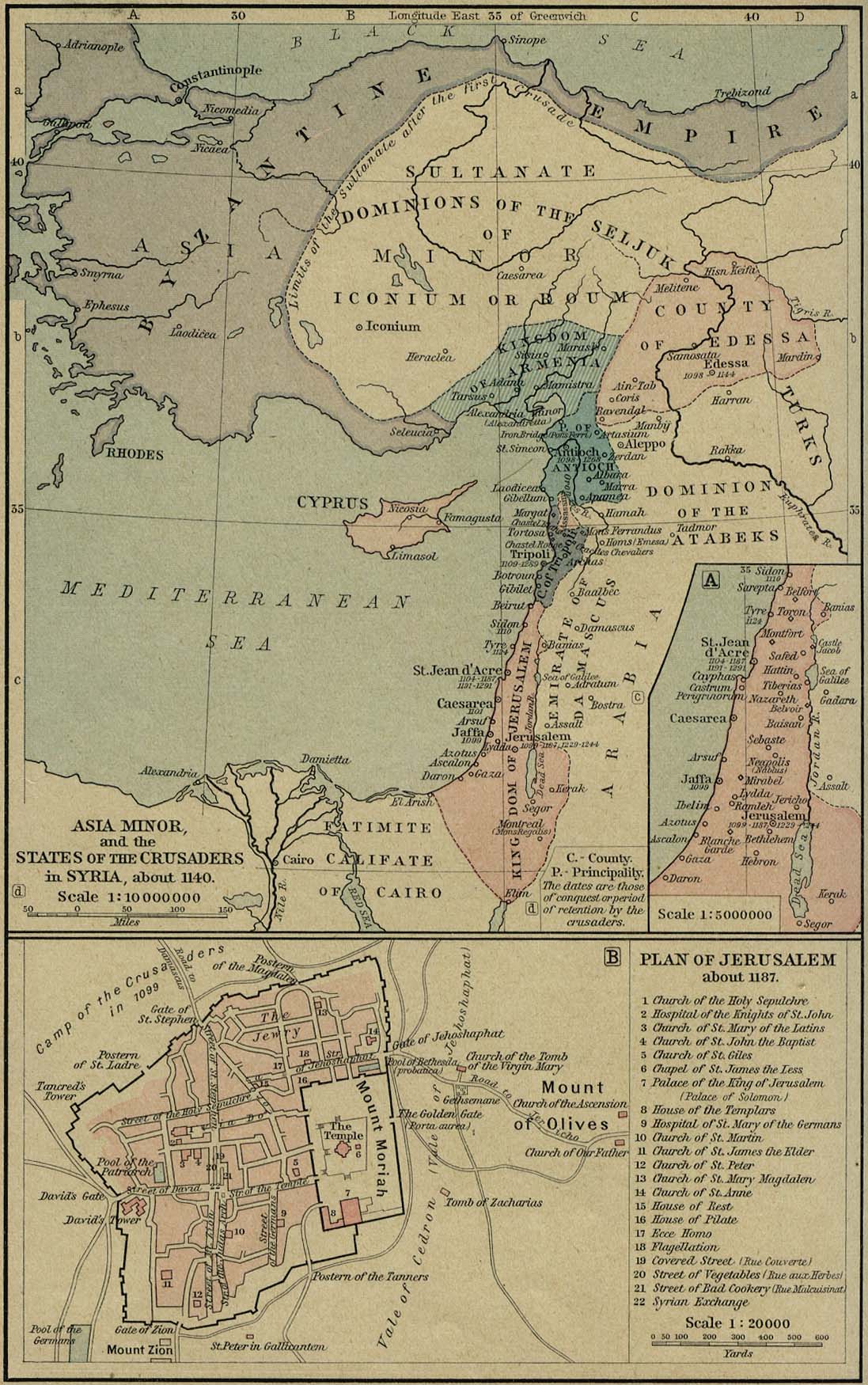
I uploaded the map I scanned. I hate how they are inconsistent with each other. As each map features different locations. I have to use AUTO Realm to make my own Crusades Map to include ALL significant locations. Too bad it eats so much ram to import the image for me to trace.

I don't know how long it will take me to make the map (Probably 40 hours). It is an obsession to reconstruct the lost Kingdom of Jerusalem.

BTW I'm getting much of my flavor inspiration from Game of Thrones of GRRM.

Wednesday, March 3, 2010

[Strategikon] War Band of Adventurers

Strategos (Military Rank 8; Status 4)

The General of the Army. Strategos mentioned are Belisarius, and Narses.

Hypo Strategos (Military Rank 7; Status 3)

Second in Command to the strategos, He is the first among the Merarchs and responsible for the center Meros called Promachos.

Merarch (Military Rank 6; Status 3)

Responsible for a Merarch, which consists of 6,000 to 7,000 men. This can vary greatly from 2-3 Moiras. In an Army there are 3 Meros, the left, right and center. A meros is also known as a Durongoi or Division.

Moirarch (Military Rank 5; Status 3)

Responsible for a Moira, which consists of 2,000 to 3,000 men. This can vary greatly from 5 to 10 Tagmas. A Moirarch is also called a Chilliarch, Duke or Dux. An example of a Moirarch or Dux is Eses of the Isaurians.


Tribune (Military Rank 4; Status 3)

Responsible for a Tagma which consists of 300 to 400 men. This can vary greatly from a large 6-8 Pentekons to 3-4 Hekatons. Also known as: Taxiarch, Count, Commitatus or Commes. Tagma is also known as a Banda, Cohort, and Company.

Illarch (Military Rank 3; Status 2)

Second in command of a Tagma, and is first among the Hekatonarchs.

Hekatonarch (Military Rank 3; Status 1)

Responsible for a Hekaton (100 men). He commands 10 Dekarchs and Dekarchies. He is also known as a Centurion.

Pentekontarch (Military Rank 2; Status 1)

Responsible for a Pentekon (50 men). He commands 5 Dekarchs and Dekarchies.

Non-Commissioned Officers:

Dekarch (Military rank 1; Status 0)

Responsible for 9 other men. He commands a Dekarchy which is also known as a Squad or Conteberium. There are 5-10 Dekarchs and Dekarchies in one Tagma.

Pentarch (Military rank 1; Status 0)

Responsible for 4 other men and the vanguard.

There is 1 Pentarch per squad.

Tetrarch (Military rank 1; Status 0)

Responsible for 3 other men and the Rear Guard.

There is 1 Tetrch per squad.

Cape Bearer (Military rank 1; Status 0)

Responsible for welfare of the Tribune, and Tagma Quartermaster.

Flag Bearer (Military rank 1; Status 0)

Responsible for the banner and a place of great honor.

There are 2 Heralds per Tagma, one is the Tribune's banner and the second one is the Illarch's.

Herald (Miltiary rank 1; Status 0)

Responsible managing the morale of the men and communication with the Tribune.

There are 2 Heralds per Tagma.


Adventuring party. The Tagma is one of the best level of military organization for adventuring. Even the name sounds appropriate for adventurers: Band , Cohort, or Companys. There are a diverse amount of roles to be filled in a Tagma as mentioned above:

  • The Commander

  • Second in Command (illarch)

  • Captains (Hekatons)

    • Intelligence Chief (Rec)

    • Vanguard (Heavy)

    • Rear guard

    • Skirmishers

  • Quartermaster (Cape Bearer)

  • Chief Combat Engineer

  • Heralds (Bards and Diplomats)

  • Spies (Enemy Infiltrators and Scouts)


Infantry Dekarchy/Squad Basic Kit $4,898.

  • Wagon $680, carries up to 638/ 680lbs

  • Large Mule $2,000

  • Group Basics $50; 20lbs

  • Axe $50; 4lbs

  • Saw $150; 3lbs

  • Scythe $15; 5lbs

  • Hammer $15; 1lb

  • First Aid Kit $50, 2lbs

  • 2 4-man Tents $300; 60lbs

  • 18 (2 gallon, filed) Cask $324; 313lbs

  • 4 Baskets $40; 4lbs (holds 4 gallons each)

  • 2 Hatchets $30; 2lbs

  • 2 Picks $30; 16lbs

  • 2 Shovels $24; 12lbs

  • 6 Plumbata $120; 6lbs

  • 30 Caltrops $300; 10lbs

  • 360 rations $720; 180lbs

  • 2 Servants $675/ mo.

Cavalry Dekarchy/Squad Basic Kit $77,742.5

added to the basic infantry when for cavalry. This is for 41 horses (11 mules, 20 reserve horses, and 10 in use horses).

  • 10 Wagon $6,800; carries up to 5478/ 6800lbs

  • 10 Large Mule $20,000

  • Feed (41 horses 10 days) $102.5, 2050lbs

  • 28x 15gal-Barrels $840 280lbs.

  • Water 3157lbs (1 day without forage)

  • 20 horses $50,000

  • 8 Servants $2,700/mo.


Strategikon: Teasing out and its Details

The winds have died for my Crusader Era write ups. I'll wait till the winds blow back at them again. Meanwhile.

The translation problems are plenty in the strategikon and history of wars I to VI. Its hard to understand what is being said when the writers don't have paragraph breaks because they trying to save space.

If you look at the History of Wars I to VI, you will notice that it was written in huge blocks of paragraphs. Imagine how it looked like in old parchment or vellum, where the scribes had to compress everything being said. Conversations were not broken up to lines and ideas were not separated by paragraphs, things we take for granted in our medium rich era.

The History of Wars V: The Gothic War part I is a great example of a military campaign for Gamers. I highly recommend reading it. Although, bringing up a richness of detail to the drab writing may require a ton of prior reading about everything else medieval and ancient.

What I can do to fill this blog up with my commentary regarding the History of Wars. Particularly interesting Game-Related pedantry regarding what is going on in the chapters. I've teased carefully

1 Stade = 185m
1 Centenaria = 5lbs of Gold or 7200 Nomismata or 360 Justinian era Solidi or $100,000 in GURPS 2004 dollars. You will notice inconsistencies often, using 1-3C, 6-7C, 9-10C terms. Remember that that scribes had to rewrite these books in different eras when the quality suffered and new leaders came into power with their own generals. So there will be an inconsitency in the terms.

1 bowshot is 300m

I was going back and forth with Strategikon and History of Wars and there was a lot of things that finally made sense to me.

The significant commanders named are typically Tribunes, Counts or Taxiarchs (or in the Latin Comitatus or Company Commander). It is implicit that these guys have with them 300-400 troops or horsemen. So the names mentioned, Constantinus, Bessas, Peranius, Valentius, Magnus, Innocentus, Herodian, Paulus, Demetrius, and Ursicinus are Tributes and their Bands (Banda/Tagma/Cohorts) are assumed to be with them.

Each Tribune has his own entourage. He has with him a number of Hekatonarchs or Captains for every 100 men he has. One of these captains are his second in command and has is own Banner, in case the Tribune falls. The 2nd in command is called an Illarch.

Each Band or Company has 300-400 men. For Cavalry 20% is heavy cavalry, 20% well-equipped horse archers or medium cavalry, and 60% inferior heavy cavalry or light cavalry.

The entourage is composed of the Illarch, the Hekatonarchs, the Cape Bearer (Orderly/Batman or Personal Servant/Steward and counts as the Quartermaster), 2 Scouts (consider them light elements and Intelligence Officer), surveyors (with the baggage, they count as an engineer elements), 2 heralds (public relations officers), 1 servant for every 4 soldiers, 1 mule for every 10 soldiers, 1 baggage guard soldier for every 4 mules, 2 extra horses for every horseman, 1 grooms for every 4 horses.

By my calculations a Bandon (cavalry) of 400 would have: 300 servants, 40 mules, 800 horses, and 40 non combat personel.

GURPS mass combat:
8 Merc. Fine Horse Archer elements $576 (TS 32)
8 Merc. Good Horse Archer elements $432 (TS 24)
8 Merc. Horse Archer elements $288 (TS 16)
16 Merc. Light Cavalry Elements $480k (TS 32)
$1,776k (TS 104)
$888k for TS1776 baggage

For a Tagma (infantry) of 400, that would just be 100 servants, 40 mules, and 40 non-combat personnel. Romans have a ratio of 2/3 heavy infantry to 1/3 medium infantry or bowmen

12 Bowmen elements $96 (TS 24)
8 Good Heavy Infantry elements $96 (TS 42)
18 Heavy Infantry elements $144 (TS 64)
2 light infantry elements $16 (TS 4)
2 Engineers $12 (TS 1)
$364k (TS 135)
$182k for TS364 baggage

Interesting tidbit, Theodatus asked for a bribe of an estate that would be worth 12 centenaria a year. This equates to 1 cenenaria a month or $100,000 a month. At TL 3 it would appear a wealth multiplier of x140 or 50% greater than Filthy rich. If it was GOLD and not "earnings" then converting the earnings would generate a loss of 90% and one would assume a x1,500 wealth multiplier. This makes it more likely he mean, "earnings" and not gold. At x1,500 that would be as wealthy as a Baron with his own armies.

Saturday, January 16, 2010

House Baldwin Territories

House Baldwin. There is a lot of area that makes up the relatively small but significant Kingdom of Jerusalem. In the setting, House Baldwin lived on and the kingdom of Jerusalem became stabilized because of the man power generated by the Latin exodus.

Millions of Europeans tried to escape the Nomad Horde. This increased the capable manpower available for sustaining and establishing the Latin Kingdom. As the population swelled, there was pressure for greater organization and fairer distribution of the limited resources of Palestine.


House Baldwin was in a decline towards the 13C, bowing before more powerful nobles and houses that arrived from the west. It was in the outbreak of civil wars where the house matured into a cohesive middle ground between the European and the Palestinian inhabitants.


Interestingly, the inheritors of House Baldwin legacy are not related by blood to the original line, instead it has become a common practice to adopt capable heirs regardless of blood relation. This is because of the savagery of the civil war, that attempted to unify the fractured lands against the threats of their neighbors as quickly as possible. This meant the soldiers were forgiven, but their masters, the heirs, and families, were punished severely


Instead of organizing it per City or Town, I feel the organization is best achieved through groups of various networks. A group of settlements strategically depend and culturally connected best represent a fiefdom, more precisely than by individual city or town.


There are too many unknown villages that exist within each of these territories to be completely ignored. These villages can serve as the background of so many potential adventures. Characters who are men-at-arms will need these obscure villages as part of their background.


The title has a link of the "Best" map for running this game I have found so far. Looking at my copy of GURPS Fantasy Harkwood inspires me to do a much better job.


Next Up... (hopefully)

Random Village Generator - *(what I want out of a village generator) This should be able to roll up the following: Village main economic produce/role, secondary economic role, power center (religious, military, bureaucratic, noble), condition (wealth, morale), current problem in the minds of the population, current problem of the "power center" (which can be different from the people) and... anything else that will speed up GM improv...


Random NPC Generator - Looking for one online that will do European names (germanic or french).


Principality of Antioch (16 locales)
  • Antioch (town, now city)
  • Albara

  • Marra

  • Apamea

  • Zerdan

  • Artasium

  • St. Simeon

  • Laodicea /Latakieh

  • Gibellum

  • Alexanderetta

  • Castle Biza (oldenbourg p. 312)

  • Castle Athareb (oldenbourg p. 312)

  • Castle Kafartab (oldenbourg p. 312)

  • Artasium

  • Zerdan

  • Artasium

County of Edessa (10 locales)

  • Edessa

  • Ain-Tab

  • Coris

  • Ravendal

  • Madrin

  • Melitene

  • Hisn-Keifa

  • Samosata

  • Turbessel

  • Tulupe

Principality of Damascus (16 locales)

  • Damascus

  • Adratum

  • Bostra

  • Assalt

  • Baalbec / Baalbek

  • Emesa

  • Tadmor

  • Hamah

  • Gadara

  • Homes (oldenbourg p.301)

  • Rasheiya (oldenbourg p.301)

  • Kiswe (oldenbourg p.301)

  • Ezra (oldenbourg p.301)

  • Mazerib (oldenbourg p.301)

  • Bosra (oldenbourg p.301)

  • Jerash (oldenbourg p.301)

Principality of Allepo (6 locales)

  • Allepo (town, now city)
  • Artasium

  • Manby

  • Harran

  • Rakka

  • Shaizar (oldenbourg p.301)

Principality of Armenia (5 locales)

  • Adana

  • Tarsus

  • Tunor

  • Mamistra

  • Marask / Marash

County of Tripoli (10 locales)

  • Tripoli (town, now city)

  • Arqa (oldenbourg p. 375)

  • Margat

  • Tortosa

  • Castle Rouge

  • Bortoun

  • Gibilet

  • Mons Ferandus

  • Chaedes Chaveliers

  • Apelias

Principality of Jerusalem (20/sq km; Pop 420,000) (39 locales)

  • Jerusalem (Pop 12,500)

  • Beirut

  • Sidon

  • Tyre

  • Banias

  • Acre

  • Cesarea

  • Arsuf

  • Jaffa

  • Ibelin

  • Azotus

  • Ascalon

  • Gaza

  • Daron

  • El Arish

  • Kerak of Moab

  • Segor

  • Kerak of Monreal

  • Elim

  • Belfort

  • Toron

  • Montfort

  • Safed

  • Castle Jacob

  • Hattin

  • Tiberias

  • Nazareth

  • Belvoir

  • Baisan

  • Sebaaste

  • Neapolis

  • Maribel

  • Lydd

  • Jerico

  • Ramleh/ Ramla

  • Blanche Garde

  • Bethlehem

  • Hebron

  • Daron


Wednesday, January 13, 2010

A better map of 12C Crusader Palestine

The title is a link to a better resource for the Kingdom of Jerusalem 15C.

4950 Villages
30 towns
6 Cities
1 Capital city

I have to organize them into "districts" where the surrounding lands and their lords follow a chain of command centering to the Town or City. That's around 7 Major districts, and further divides into towns and their surrounding villages.

I came from a lasik evaluation and laser eye correction (reinforcement of my retina walls). So I can't do a lot of reading and writing, because I lost my near sight because of pupil dilation. Its been 7 hours since I left the clinic and the meds haven't worn off yet.

Thursday, January 7, 2010

Kingdom of Jerusalem List

Basically using the guidelines and exel sheet of Medieval Demographics Made easy I'll work with these settlements. Basically for simplicity their major centers and the region is named the same. So the small villages around Jersulem will be simply referred to as Jerusalem. They will have their individual names which is free to be made up since alot of these maps are unreliable and it is an altered history after all.

I have not yet arranged the key fiefs according to their population. I plan to roll randomly what became what, then make up the rest. Since its random I don't have to worry about trying to get it accurate and saves me HOURS researching the actual political power. I'll just base the power structure after I roll up the value of each fief.

Population will be the most key determinant for political power given the era. The map in the link is a nice LOTR-ish map. There are more maps if you use Palestine as a search term and look form maps bigger than 2Mpix. Given a population of +2M I can't possibly make enough NPCs. I'll just have up to the GM rule of 7 key figures (GURPS mysteries) beyond the ones i've already fleshed out in my previous write ups.

To the other GMs out there. If it gets Boring reconsider the amount of time you are budgeting or do it at smaller increments (which go faster). What I'm doing is that I'll just use the exel sheet and bulldoze my way to filling up the Political crap out of these centers. Probably 2 hours TOPS!

Note that because of the climate these "Nation" is very "eastern" with their armor and dress. They wear very light and fight based on endurance and speed.

Major Fiefs
(Cities, Provinces)
  • Jerusalem
  • Acre
  • Tyre
  • Damascus
  • Ascalon
  • Antioch
  • Tripoli
  • Edessa
  • Mosul
  • Beruit
  • Galilee
  • Sidon
Great Fiefs (Towns, Large Settlements)
  • Nazareth
  • Bethel
  • Berea
  • Bethany
  • Bethlehem
  • Hebron
  • Ralma
  • Jaffa
  • Haifa
  • Tiberias
  • Siloh
  • Gaza